Property Clock: Which markets will boom or bust?

Tracking the housing market is rarely simple, and picking its next turn is harder again.
Each month, independent valuer Herron Todd White maps Australia's 50 biggest markets on its Property Clock, showing which are rising, peaking, cooling or bottoming out in the cycle.
So where does your market sit right now? Here's what the latest clock shows, and what has shifted since we last checked in.

Get a free property value estimate
Find out how much your property is worth in today’s market.
Markets on the rise
The Reserve Bank lifted the cash rate again in late September, after leaving rates on hold through June and August.
The clock has rotated noticeably since our last update as a result. Most markets are still in the rising half, but a good number have moved from climbing to cresting.
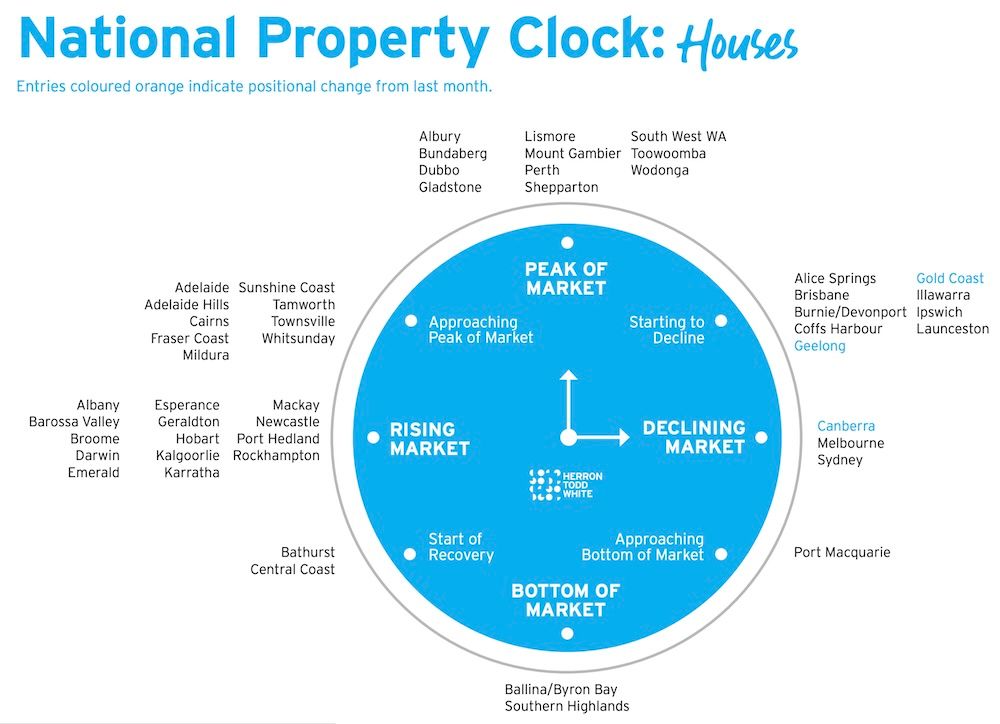
For houses, Bathurst and the NSW Central Coast are the only two markets now placed at the start of a fresh upswing.
The unit clock has the Central Coast there too, alongside Canberra, Melbourne and Newcastle.
Western Australia dominates the rising segment, with Albany, Broome, Esperance, Geraldton, Kalgoorlie, Karratha and Port Hedland all still gaining ground.
Darwin and Hobart are the only capitals left in that group, joined by Queensland's Mackay, Rockhampton and Emerald.
Dubbo, Tamworth, Townsville and the Fraser Coast sit in the rising group on the unit clock, a step behind their house markets, which have each moved further around the dial.

Markets at or approaching their peak
This is where most of the movement has been. Twenty markets now sit at or approaching their peak for houses, up from sixteen in our last update.
Perth houses have pushed all the way to the peak of the market, with Perth units a step behind and approaching theirs.
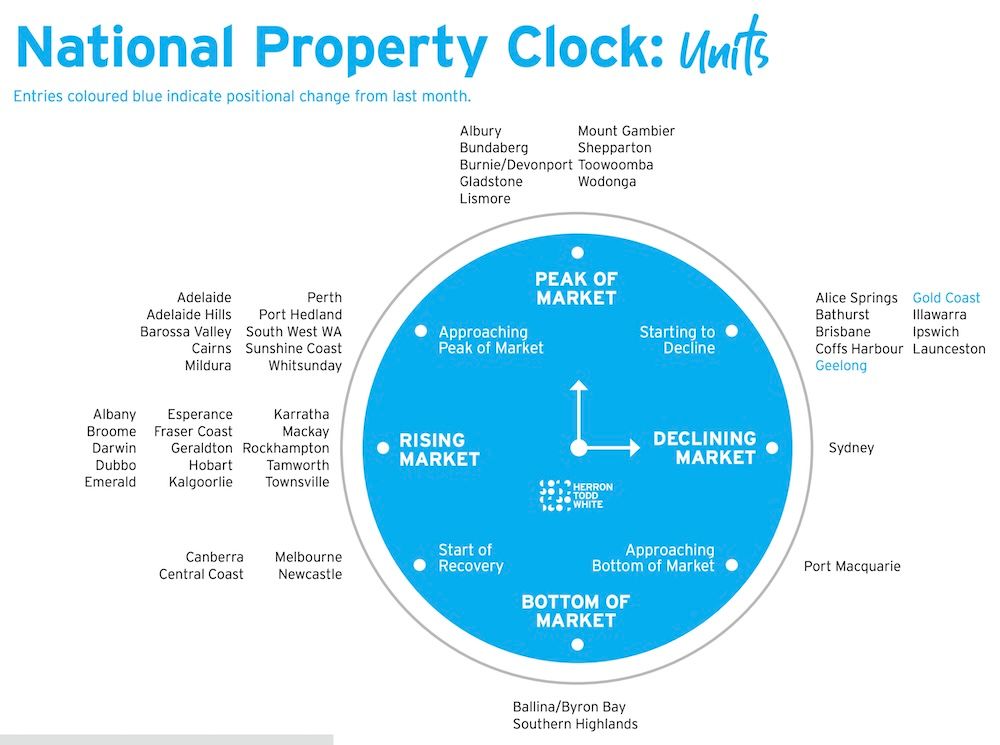
Gladstone and Shepparton have joined them at the top on both clocks, along with Albury and Wodonga on the Murray, and South West WA for houses.
Bundaberg, Lismore, Mount Gambier and Toowoomba all hold their place at the peak, with Dubbo at the top for houses and Burnie/Devonport for units.
Adelaide and the Adelaide Hills have moved up to approaching peak on both clocks, joining Cairns, Mildura, the Sunshine Coast and Whitsunday.
Tamworth, Townsville and the Fraser Coast are approaching their peak for houses, while the Barossa Valley and Port Hedland do the same on the unit clock.
Markets declining or at the bottom
The right-hand side of the clock has filled out considerably since our last update.
Sydney is now placed in the declining segment on both clocks, having been listed there for houses alone last time.
Melbourne houses remain in decline, while Melbourne units are unchanged and still sit at the start of a recovery.
Canberra houses have made the single biggest move of this edition, shifting from approaching their peak to declining, though Canberra units have not followed and remain early in a recovery.
Brisbane has turned as well, moving to the beginning of a downswing on both clocks after sitting at or near its peak last time.
It's joined there by the Gold Coast, Ipswich, the Illawarra, Coffs Harbour and Geelong, along with Alice Springs and Launceston. Burnie/Devonport is in that group for houses and Bathurst for units.
It's worth remembering what the clock is and isn't. It's a valuer's read on where a market sits in its broader cycle rather than a record of what prices did last month, and one position on a diagram can't capture the range of conditions across a city of five million people.
Port Macquarie on the NSW mid-North Coast is once more the only market considered to be nearing its lowest point.
Ballina/Byron Bay and the Southern Highlands are the sole markets still sitting firmly at the bottom on both clocks.

A different perspective from Domain
Domain's latest Housing Market Forecast report takes a different cut at the same question, sorting the capitals into those it expects to fall and those it expects to keep growing.
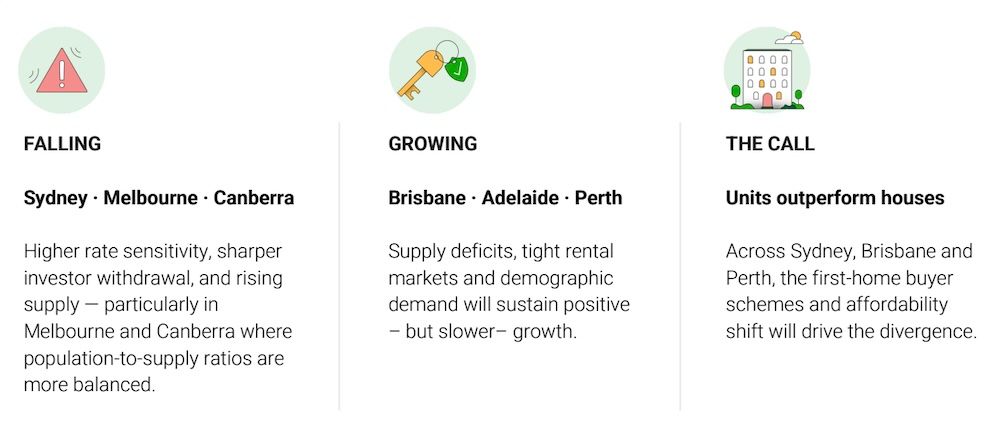
Domain places Sydney, Melbourne and Canberra in the falling group, pointing to rate sensitivity, investors stepping back and rising supply.
Brisbane, Adelaide and Perth are expected to keep growing, though at a slower pace, supported by supply shortfalls and tight rental markets.
The two views agree on Sydney and Melbourne, but part ways on Canberra, which HTW has just moved up towards its peak.
Domain also expects units to outperform houses across Sydney, Brisbane and Perth, which is a useful reminder that the house and unit clocks can tell quite different stories about the same city.
Thinking of selling?
If you're looking to get in on the action in 2026 or beyond, it's important to be as prepared as possible in order to cut through the competition and achieve a standout result.
Step 1: Understanding how your market is performing
Every market is different, and understanding your local market is fundamental to making the right selling decisions. Our guide to tracking market trends and data will help you to get a clear picture of how your market is performing and how that impacts you as a seller.
Step 2: Know what your property might be worth
Getting a free home value estimate is a great way to set a foundation for your selling expectations and begin planning the path forward.
Step 3: Get a no-obligation market appraisal from a top real estate agent
Understand what your property could sell for in the current market by speaking to the top-performing agents in your suburb. Comparing top agents in your area will help you find the perfect partner for your selling journey and move towards a successful result.
Step 4: Finally, get your property listing ready
Taking a thorough approach to preparing your home for sale is another critical step. From cleaning, decluttering, painting and performing other cosmetic renovations to home staging, photography and marketing, getting your property to sale-ready condition is a must.