
 - https://sketchapp.com --%3e %3ctitle%3eIcon/search%3c/title%3e %3cdesc%3eCreated with Sketch.%3c/desc%3e %3cg id='Icon/search' stroke='none' stroke-width='1' fill='none' fill-rule='evenodd' stroke-linecap='round' stroke-linejoin='round'%3e %3ccircle id='Oval' stroke='%23252525' cx='10.5145111' cy='10.5145111' r='6.99455261'%3e%3c/circle%3e %3cpath d='M15.4908752%2c15.4908752 L20.5515137%2c20.5515137' id='Line' stroke='%23252525'%3e%3c/path%3e %3c/g%3e%3c/svg%3e)


Brisbane property market news - key takeaways
- Brisbane property market softens: Brisbane dwelling values fell -1.0 per cent in August 2026, extending a quarterly decline of -2.7 per cent from the May 2026 peak, though annual growth of +10.8 per cent means values remain well above year-ago levels.
- Stock accumulating sharply: Total listings in Brisbane climbed +53.3 per cent year on year, as properties sit on the market longer and unsold stock builds, giving buyers considerably more choice than twelve months ago.
- Auction conditions favour buyers: Brisbane's auction clearance rate of 25.9 per cent for the week ending 6 September 2026 was a weak result, with 83 of 131 properties passed in and only 34 sold across all sale methods.
- Rents rising, vacancy tight: Brisbane's annual rent growth of +6.4 per cent sits above the national average, with a vacancy rate of just 0.9 per cent keeping the rental market tight for tenants despite softer conditions in the sales market.
- Rate rise looming: The RBA cash rate sits at 4.35 per cent and all four major banks expect a further 25 basis point rise, with three pointing to November 2026 as the most likely timing.

Get a free property value estimate
Find out how much your property is worth in today’s market.
Brisbane property price movements
Brisbane home values fell -1.0 per cent in August 2026, extending a quarterly decline of -2.7 per cent. The annual picture still shows meaningful growth, but the more recent quarterly and monthly figures tell a different story.
Brisbane property prices - August 2026
The median Brisbane home value sat at $1,080,142 in August 2026, down around $10,911 from the prior month. Annual growth of +10.8 per cent means values are still well above where they were a year ago, though the gap between that longer-run figure and the recent trend is widening.
| Property type | Current median price | Monthly change | Quarterly change | Annual change |
|---|---|---|---|---|
| All Brisbane dwellings | $1,080,142 | -1.0% | -2.7% | +10.8% |
Source: Cotality
Values remain -2.7 per cent below their May 2026 peak, meaning the quarterly decline has now unwound roughly the equivalent of the distance from that record high.
House prices in Brisbane
Brisbane house prices fell -1.0 per cent in August 2026, with the quarterly result of -2.9 per cent showing the correction has gathered pace since the middle of the year. The Brisbane housing market carries a strong annual gain of +10.3 per cent, though that figure is being eroded by the more recent run of monthly falls.
| Property type | Current median price | Monthly change | Quarterly change | Annual change |
|---|---|---|---|---|
| Brisbane houses | $1,180,552 | -1.0% | -2.9% | +10.3% |
Source: Cotality
The median house value of $1,180,552 represents a drop of around $11,924 over the month. Houses have declined slightly further over the quarter than the broader market, which reflects the pattern seen nationally where higher-priced segments tend to absorb a greater share of the adjustment pressure as conditions ease.
Unit prices in Brisbane
Brisbane unit prices also fell -1.0 per cent over the month, with the quarterly decline of -2.0 per cent a touch shallower than for houses. On an annual basis, Brisbane unit prices have performed more strongly, posting +13.2 per cent growth over the year to August 2026.
| Property type | Current median price | Monthly change | Quarterly change | Annual change |
|---|---|---|---|---|
| Brisbane units | $854,721 | -1.0% | -2.0% | +13.2% |
Source: Cotality
The median unit value of $854,721 was down around $8,635 over the month. The quarterly gap between houses (-2.9 per cent) and units (-2.0 per cent) is wide enough to be meaningful, suggesting units have held up somewhat better than houses through the recent period of decline, even as both are clearly tracking lower.
Brisbane property market forecasts 2026
Australia's Big Four banks publish annual house price forecasts as part of their economic research divisions, and their views on Brisbane for 2026 span a considerable range. Each bank's outlook reflects different assumptions about rate movements, migration flows, and the pace at which buyers will return to the market.
- CBA predicts Brisbane property prices to rise +8.0 per cent over 2026.
- Westpac predicts Brisbane property prices to rise +9.0 per cent over 2026.
- NAB predicts Brisbane property prices to rise +2.0 per cent over 2026.
- ANZ predicts Brisbane property prices to rise +4.0 per cent over 2026.
Westpac sits at the optimistic end of the Brisbane house price forecast range, with a +9.0 per cent call, while NAB is the most cautious of the four at +2.0 per cent. CBA's +8.0 per cent sits close to Westpac at the top of the spread, while ANZ's +4.0 per cent lands nearer the cautious end. The seven-percentage-point gap between the highest and lowest Brisbane property market predictions reflects genuine disagreement about how quickly the current soft patch will resolve.
RBA cash rate forecast 2026-2027
The RBA cash rate currently sits at 4.35 per cent. All four major banks expect the next move to be a rise, with three of the four pointing to November 2026 as the likely timing and NAB forecasting an earlier move as soon as September 2026.
- ANZ expects the next cash-rate move to be a 25 basis point rise, bringing the cash rate to 4.60 per cent.
- CBA expects the next cash-rate move to be a 25 basis point rise, bringing the cash rate to 4.60 per cent.
- NAB expects the next cash-rate move to be a 25 basis point rise in September 2026, with the risk of a further rise in November 2026 to bring the cash rate to 4.60 per cent.
- Westpac expects the next cash-rate move to be a 25 basis point rise, bringing the cash rate to 4.60 per cent.
Sally Tindall, Data Insights Director at Canstar said of the rate outlook:
"The economic narrative has taken a U-turn in the space of just a couple of days."
Tindall's observation captures the speed at which rate expectations have shifted. For Brisbane borrowers already navigating a market where values have pulled back from their May 2026 peak, a further 25 basis point rise would add to existing pressure on serviceability.
What this means for the Brisbane market
A cash rate at 4.35 per cent is already squeezing borrowing capacity for buyers in a city where the median dwelling value sits at $1,080,142. If the rate rises to 4.60 per cent as the banks broadly expect, the maximum loan most households can service will fall further, narrowing the pool of active buyers at current price levels.
The tension between the rate outlook and the Big Four's Brisbane house price forecasts is real. NAB's relatively cautious +2.0 per cent call appears more consistent with a rising-rate environment than Westpac's +9.0 per cent, and the spread between the two reflects meaningful uncertainty about how quickly sentiment and demand will recover. First-home buyers and those with smaller deposits are likely to feel the rate pressure most directly, while investors weighing Brisbane's 3.4 per cent gross rental yield against a 4.60 per cent cash rate will need to consider whether the income return justifies the financing cost.
Helpful resource: Our simple guide to tracking market trends and data will walk you through everything you need to know to be able to read the market and make a smarter selling decision.
Brisbane house prices graphs and charts
Brisbane's house price growth over the last 5 years has brought the city to a combined dwelling median of $1,080,142 as at August 2026, according to Cotality's latest figures, with values easing -1.0 per cent over the month, falling -2.7 per cent over the quarter, and still sitting +10.8 per cent higher than a year ago.
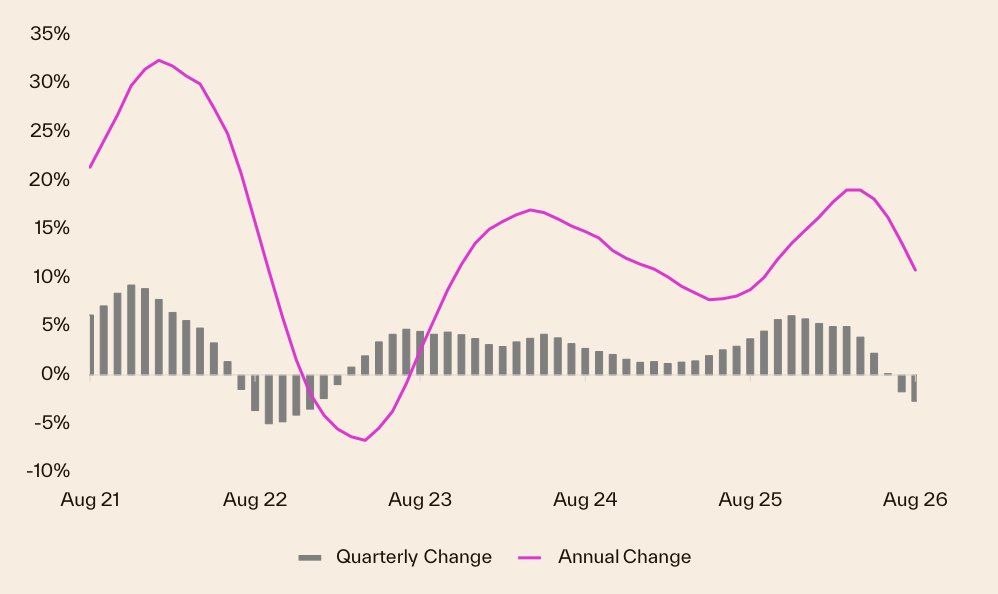
The five-year arc reflects a city that rode a long growth cycle, fuelled by strong interstate migration, constrained housing supply, and historically low interest rates in the early part of the period, before the cash rate climbing to 4.35 per cent began to weigh on buyer capacity from late 2025. Total listings in Brisbane have risen +53.3 per cent compared with a year ago, and properties are now taking nearly twice as long to sell as they were at the same time last year. Together, those two conditions help explain why values have pulled back from the May 2026 peak.
Brisbane property 30 year property price graph
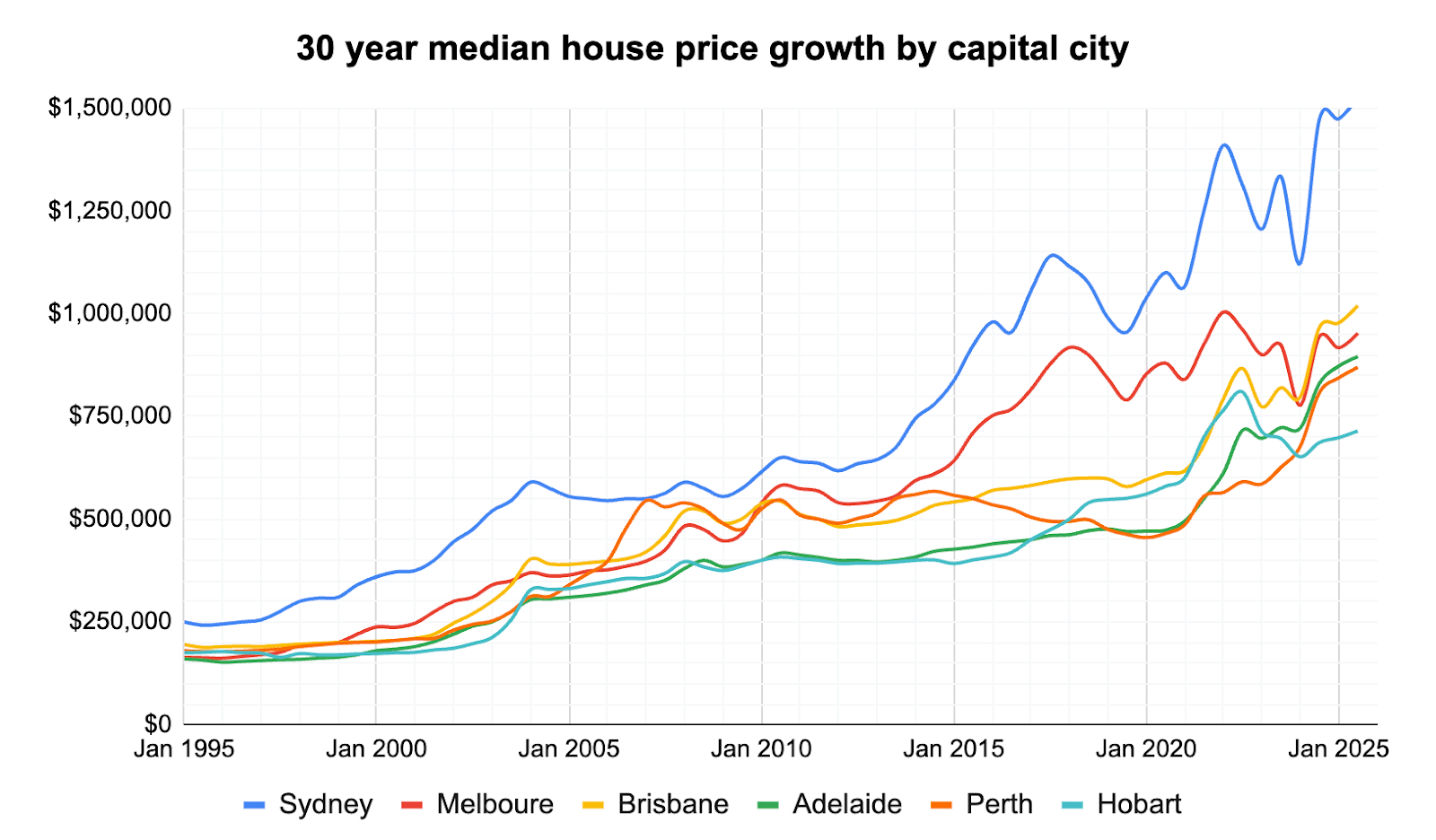
Brisbane property prices growth over the last 10 years has been pronounced, with the city moving from a traditionally affordable capital to one where median house values climbed sharply into the million‑dollar range by late 2025, reflecting years of strong demand and constrained supply. Historical research for Brisbane shows that over the past three decades, low interest rates, sustained population gains and limited new housing have been the main drivers of this long‑run appreciation.
Over the last 30 years, Brisbane has seen repeated cycles of rapid gains and shorter corrections, leaving many homeowners with substantial paper equity while making entry much harder for new buyers. Today, sentiment is mixed: existing owners feel wealthier and are reluctant to sell, while buyers — especially first‑timers — are more cautious because of high prices and elevated mortgage costs; at the same time, tight rental markets and the lead-up to the 2032 Olympics are keeping long‑term confidence relatively strong.
Brisbane selling statistics
Brisbane's selling conditions in August 2026 reflect a market where supply has grown considerably and buyer activity has pulled back. Properties are taking longer to sell, sellers are accepting larger reductions from their asking prices, and auction results point firmly toward buyers having the upper hand.
Want to know what your own property is worth? Get a free value estimate for your address.
Brisbane sales volume and days on market
Sales volumes in Brisbane fell -8.0 per cent year on year in the period to August 2026. Properties took 35 days to sell on average, up from 19 days a year ago, an increase of 16 days.
| Brisbane sales volume | Brisbane days on market |
|---|---|
| -8.0% Change from 12mo ago | 35 days 19 days 12mo ago |
Source: Cotality
Brisbane's sales volume decline of -8.0 per cent is steeper than both the combined capitals aggregate of -5.2 per cent and the national figure of -2.7 per cent, suggesting demand has eased more sharply here than across the broader market.
On days on market, Brisbane's 35 days sits below the combined capitals average of 37 days and the national average of 39 days, so while selling times have lengthened materially from a year ago, properties are still transacting somewhat faster than the averages elsewhere.
Brisbane new and total listings
New listings rose +5.4 per cent year on year, adding modestly to the pool of available stock coming to market. Total listings, however, climbed +53.3 per cent year on year, a much larger build-up driven by properties sitting on the market longer before selling.
| Brisbane new listings | Brisbane total listings |
|---|---|
| +5.4% Change from 12mo ago | +53.3% Change from 12mo ago |
Source: Cotality
The gap between the new listings figure (+5.4 per cent) and the total listings figure (+53.3 per cent) tells the story plainly: it is not a surge of new sellers pushing stock higher, but unsold properties accumulating as buyer activity slows. For buyers, this means considerably more choice than a year ago. For sellers, it means more competition from other listings and less urgency from buyers.
Brisbane vendor discount and auction clearance rates
Vendor discount measures the percentage gap between a property's initial asking price and the price it eventually sells for.
Auction clearance rate measures the share of properties offered at auction that receive a successful bid on auction day, including sales made before and after the auction under auction conditions. Together, these two figures show how much negotiating leverage buyers currently hold and how quickly the market is prepared to transact.
Brisbane vendor discount
| August 2026 | August 2025 | |
|---|---|---|
| Brisbane median vendor discount | -4.2% | -2.8% |
Source: Cotality
Brisbane's vendor discount widened to -4.2 per cent in the period to August 2026, from -2.8 per cent a year earlier. Sellers are now accepting offers an average of 1.4 percentage points further below their initial asking price than they were twelve months ago, reflecting the broader shift in buyer leverage as stock has accumulated and competition for each property has eased.
Brisbane auction clearance rates
| Brisbane | 6 Sept 2026 |
|---|---|
| Total Auctions | 131 |
| Sold | 34 |
| Withdrawn | 14 |
| Passed in | 83 |
| 76 | 25.9% |
Source: Cotality
Brisbane recorded a clearance rate of 25.9 per cent for the week ending 6 September 2026, from 131 auctions. Of those, 83 properties passed in and only 34 sold across all sale methods. A rate in the mid-to-upper 20s sits well below any threshold that could be described as buyer-seller balance, and at this level conditions favour buyers clearly, with a large proportion of vendors unable to achieve a sale on auction day at their price expectations.
Thinking of selling? Compare top-performing local agents in your suburb to find the right fit for your sale.
Get a deeper insight into how Brisbane sellers are faring in 2026 and what could be on the horizon for the year ahead with some of our latest articles.




Brisbane property investing
Brisbane's rental market continues to put upward pressure on rents while keeping available stock tight, a combination that shapes conditions for both tenants and investors. Values have pulled back from their May 2026 peak, but the rental side of the equation has moved in a different direction to sales.
Helpful resource: Estimate the capital gains tax on a sale with our free calculator.
Brisbane rental market
The table below covers annual rent growth, gross rental yield, and the split between houses and units across Brisbane and other major markets. These figures show how Brisbane sits relative to the national picture and other capital cities.
| Location | Rental rates | Rental yield | Annual change in rents, houses | Annual change in rents, units |
|---|---|---|---|---|
| National | 5.7% | 3.8% | NA | NA |
| Combined Capitals | 5.7% | 3.6% | NA | NA |
| Combined Regional | 5.8% | 4.3% | NA | NA |
| Sydney | 4.8% | 3.3% | 5.3% | 3.9% |
| Melbourne | 5.0% | 4.0% | 5.1% | 4.9% |
| Brisbane | 6.4% | 3.4% | 6.7% | 5.6% |
| Adelaide | 5.8% | 3.6% | 5.8% | 6.0% |
| Perth | 8.0% | 3.9% | 8.1% | 7.4% |
| Hobart | 7.9% | 4.4% | 8.5% | 6.0% |
| Darwin | 11.4% | 6.3% | 12.0% | 10.5% |
| Canberra | 3.2% | 4.3% | 4.0% | 1.4% |
Source: Cotality
Brisbane recorded annual rent growth of +6.4 per cent, above both the national and combined capitals averages of +5.7 per cent, with houses (+6.7 per cent) growing faster than units (+5.6 per cent). The gross yield of 3.4 per cent sits below the combined capitals average of 3.6 per cent, which tells you that values have climbed faster than rents over recent years, compressing the income return available to investors entering the market now.
Brisbane vacancy rates
The vacancy rate is one of the clearest indicators of rental pressure: when few properties sit empty, landlords hold more pricing power and tenants have fewer options to choose from. SQM data shows that Brisbane's vacancy rate eased from 1.0 per cent a year ago to 0.9 per cent in August 2026, a modest but meaningful tightening.
| Location | Aug 2026 vacancy rates | Aug 2026 vacancies | Aug 2025 vacancy rates | Aug 2025 vacancies |
|---|---|---|---|---|
| National | 1.3% | 41,039 | 1.2% | 37,742 |
| Sydney | 1.7% | 12,821 | 1.4% | 10,211 |
| Melbourne | 1.8% | 9,534 | 1.8% | 9,620 |
| Brisbane | 0.9% | 3,090 | 1.0% | 3,423 |
| Adelaide | 0.6% | 1,019 | 0.8% | 1,257 |
| Perth | 0.6% | 1,192 | 0.7% | 1,389 |
| Hobart | 0.6% | 158 | 0.5% | 144 |
| Darwin | 0.4% | 94 | 0.5% | 134 |
| Canberra | 2.1% | 1,264 | 1.6% | 978 |
Source: SQM Research
Brisbane's vacancy rate of 0.9 per cent is well below the national rate of 1.3 per cent, and the city has moved in the opposite direction to the national trend, which edged higher year on year. With only 3,090 properties available, the pool of rental stock on offer is thin, and tenants searching for a home face a market that has tightened rather than opened up over the past year.
Louis Christopher, Managing Director at SQM Research said in the latest rental market report:
"The national vacancy rate is 1.3%, but that hides a market moving in two directions. Sydney has 26% more vacancies than a year ago and Canberra 29% more, while Brisbane, Perth, Adelaide and Darwin have fewer than they did last August."
Mr Christopher's observation maps directly onto Brisbane's position in the table. The city sits firmly in the group where supply has contracted, and with vacancy already below 1 per cent, further tightening would leave renters with very limited alternatives heading into the summer leasing season.
Highest growth areas in Brisbane
Brisbane's strongest annual price gains in August 2026 came from a spread of regions across the city's inner west, outer south and northern corridors. The table below ranks the top 10 Statistical Area Level 3 (SA3) regions for Greater Brisbane by annual percentage change, an SA3 is an Australian Bureau of Statistics classification that typically groups several neighbouring suburbs into a single statistical region.
| Rank | SA3 Name | SA4 Name | Median Value | Annual % Change |
|---|---|---|---|---|
| 1 | Sherwood - Indooroopilly | West | $1,146,034 | 17.3% |
| 2 | Beenleigh | Logan - Beaudesert | $900,981 | 14.9% |
| 3 | Loganlea - Carbrook | Logan - Beaudesert | $970,262 | 14.7% |
| 4 | Sandgate | North | $1,114,014 | 14.6% |
| 5 | Forest Lake - Oxley | Ipswich | $985,333 | 14.0% |
| 6 | Caboolture | Moreton Bay - North | $930,528 | 13.9% |
| 7 | Beaudesert | Logan - Beaudesert | $893,888 | 13.9% |
| 8 | Redcliffe | Moreton Bay - North | $1,084,959 | 13.5% |
| 9 | Strathpine | Moreton Bay - South | $958,542 | 13.2% |
| 10 | Ipswich Inner | Ipswich | $874,451 | 13.2% |
Source: Cotality
Highlights for Brisbane's high growth areas
- Sherwood - Indooroopilly: Ranked #1 with annual growth of +17.3 per cent and a median value of $1,146,034, Sherwood - Indooroopilly posted the strongest result across Greater Brisbane by a clear margin. The region's proximity to the CBD, established school catchments, and riverside appeal have kept buyer interest steady in suburbs such as Indooroopilly and Chelmer, supporting values even as broader Brisbane conditions soften.
- Beenleigh: Ranked #2 with annual growth of +14.9 per cent and a median value of $900,981, Beenleigh sits at the more affordable end of Brisbane's southern corridor and has attracted buyers seeking relative value within reach of the city. Suburbs such as Eagleby and Holmview are among the more active pockets in the region.
- Loganlea - Carbrook: Ranked #3 with annual growth of +14.7 per cent and a median of $970,262, this Logan region sits between the Beenleigh corridor and the bayside, drawing buyers who want more space at a price point below the Brisbane median. Suburbs such as Shailer Park and Loganholme have been consistent performers within the area.
- Sandgate and Forest Lake - Oxley: Ranks #4 and #5 cover Brisbane's northern bayside and south-western fringe respectively. Sandgate posted +14.6 per cent annual growth with a median of $1,114,014, supported by coastal appeal and proximity to bay suburbs such as Shorncliffe and Brighton. Forest Lake - Oxley gained +14.0 per cent, reaching a median of $985,333, with suburbs such as Forest Lake and Oxley drawing buyers seeking affordability within the western rail corridor.
- Caboolture through Ipswich Inner: Ranks #6 through #10 form a broad outer ring spanning Brisbane's north, south-west and west. Caboolture (+13.9 per cent, $930,528) and Beaudesert (+13.9 per cent, $893,888) reflect ongoing demand in Brisbane's outer growth corridors, where land sizes and price points continue to attract first-home buyers and families. Redcliffe (+13.5 per cent, $1,084,959) adds a coastal dimension to the group, with suburbs such as Margate and Scarborough among its drawcards, while Strathpine (+13.2 per cent, $958,542) and Ipswich Inner (+13.2 per cent, $874,451) round out the list as more affordable SA3s in the top ten, with Ipswich and Brassall among the better-known suburbs in that western pocket.
Thinking of selling or investing in Brisbane? Compare local agents or get a free property report with OpenAgent.
View agent & property tools

Our powerful property tools


 - https://sketch.com --%3e %3ctitle%3eicons / icon-chevron-down%3c/title%3e %3cdesc%3eCreated with Sketch.%3c/desc%3e %3cg id='icons-/-icon-chevron-down' stroke='none' stroke-width='1' fill='none' fill-rule='evenodd'%3e %3crect id='Icon-container' x='0' y='0' width='24' height='24'%3e%3c/rect%3e %3cpolygon id='Shape' fill='%2300AB55' points='12 14.3357864 5.20710678 7.54289322 3.79289322 8.95710678 12 17.1642136 20.2071068 8.95710678 18.7928932 7.54289322'%3e%3c/polygon%3e %3c/g%3e%3c/svg%3e)