
What changing seller behaviour means for the referrals you receive

When a referral reaches you, one of the first things you’ll see is when the homeowner expects to sell. Over the past year, what that timeframe tells you has shifted in some useful ways.
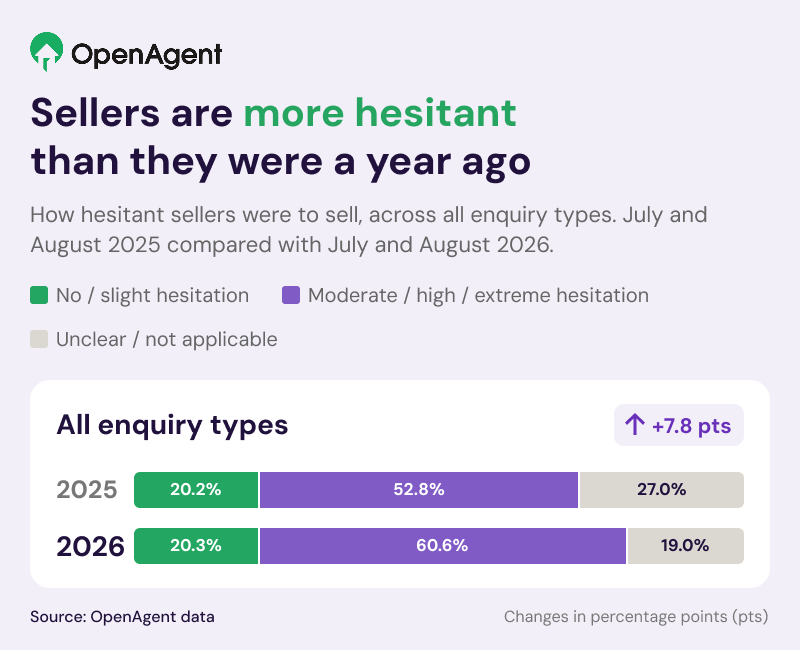
We compared July and August this year with the same months in 2025, across our conversations with homeowners considering a sale. Hesitation has risen, with 61 per cent now showing moderate or higher hesitation, up from 53 per cent.
But that doesn’t mean the serious sellers have gone anywhere. Kevin Kong, OpenAgent’s Head of Data, noted that the ratio of highly motivated sellers to exploratory ones has stayed fairly consistent year on year.
What has changed is how each group behaves once they’re talking to us. Here’s what that looks like across the homeowners we speak with.
When a homeowner says now, they mean it
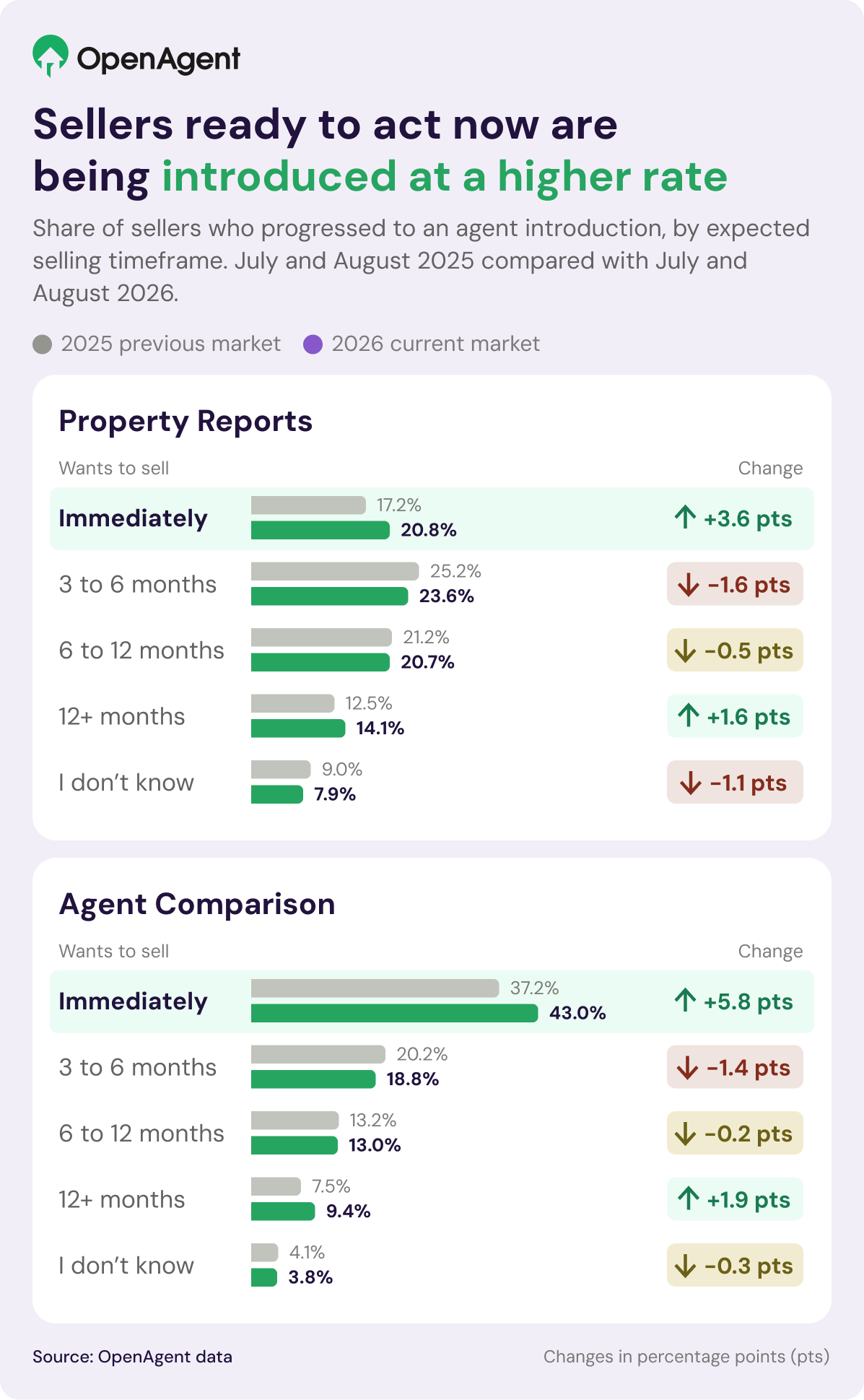
Homeowners who tell us they want to sell immediately are more likely to agree to an agent introduction than they were a year ago.
Among those comparing agents, 43 per cent agreed to an introduction, up from 37 per cent. Among those requesting a property report, it rose from about 17 to 21 per cent.
Kevin said that’s consistent with what we’ve seen in previous slowdowns.
“Customers who explicitly state they intend to sell soon generally proceed to market on their usual timelines, regardless of broader conditions,” he explained.
In other words, a slower market isn’t changing their plans. A separation, a deceased estate or a job interstate tends to come with a timeline that doesn’t bend to conditions.
A long timeframe isn’t a dead end
The less obvious finding sits at the other end of the scale.
Homeowners planning to sell in 12 months or more were also more likely to agree to an introduction this year, with the rate up by around two percentage points among both those comparing agents and those requesting a property report.
Those planning to sell in three to six months moved the other way, dipping slightly in both groups.
They’re modest shifts, and we wouldn’t read too much into them on their own. But they suggest a homeowner with a long horizon isn’t necessarily disengaged, and some are choosing to start the conversation with an agent well before they list.
Kevin added that homeowners who don’t indicate an immediate need to sell “take significantly longer to list”, so the payoff from those referrals is usually further down the track.
Investor referrals are a different conversation
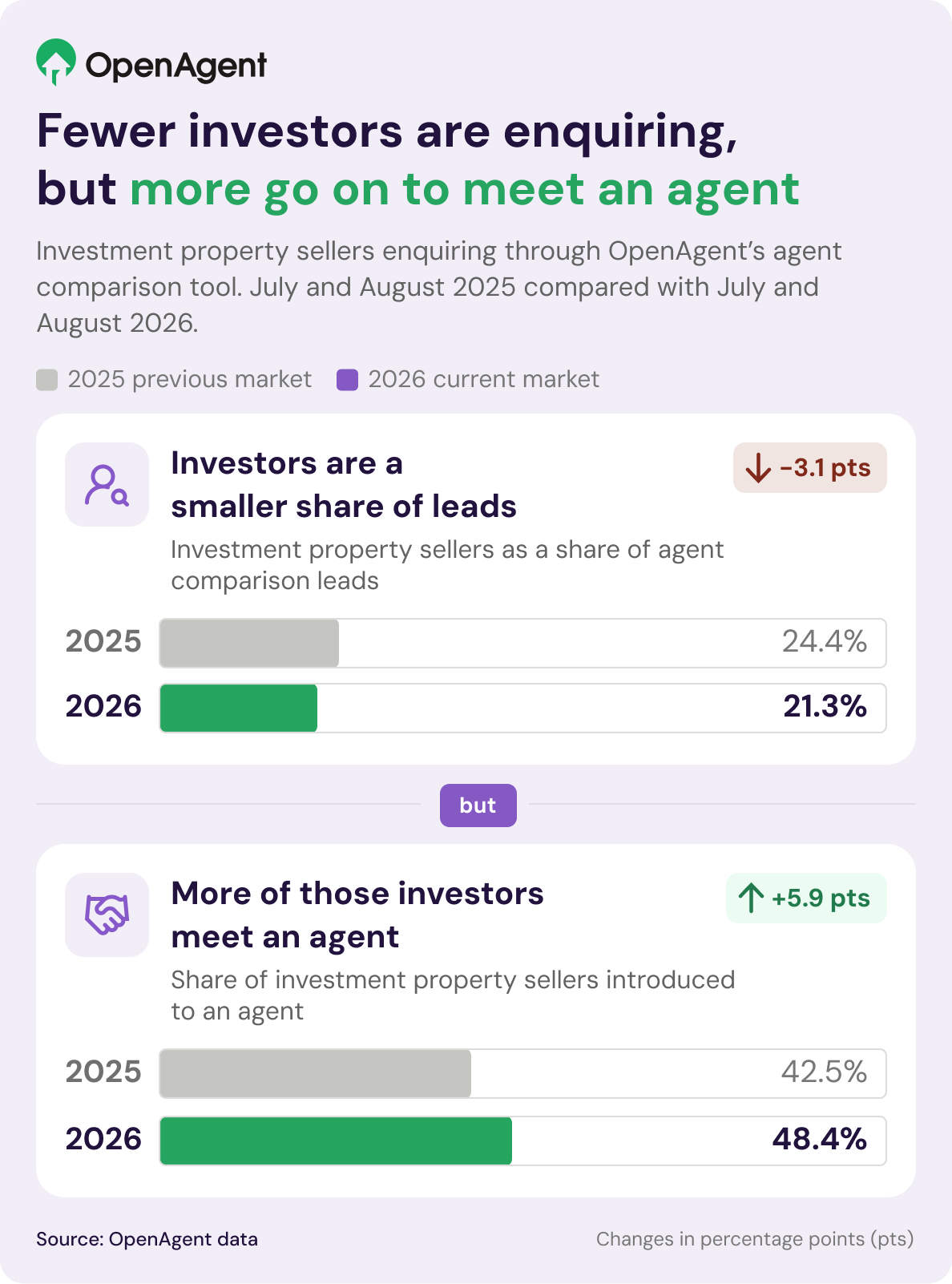
Investors make up a smaller share of the homeowners comparing agents through us, falling from 24 to 21 per cent nationally.
Yet those still coming through are more likely to agree to an introduction, with the rate rising from 43 to 48 per cent. In NSW the shift was sharper again, from 39 to 51 per cent.
Kevin’s read was that this year’s negative gearing changes were part of the story.
Under the changes, which take effect in July 2027, negative gearing on residential property will be limited to new builds. Established properties held before the May budget are grandfathered, but that protection doesn’t carry over to a replacement established property.
“Existing investors are heavily disincentivised to sell unless they are exiting the property market entirely,” he noted.
If that holds, an investor referral today is more likely to be someone leaving the market than someone reshuffling their portfolio.
What hesitant homeowners are worried about
We also looked at what’s behind the hesitation, using a recent sample of conversations with homeowners who were unsure about selling.
One of the most common concerns was certainty about value. Plenty of hesitant homeowners aren’t sure what their property is worth in the current market, and don’t want to commit until they are.
Another was reservations about choosing an agent. That covered commission, but also uncertainty about whether an agent’s advice would put their interests first.
Others wanted to finish renovations before selling, or were waiting to see whether they could achieve the price they had in mind.
None of these concerns means a homeowner won’t sell. Most come down to wanting more certainty before they commit.
What happens before an introduction
For the homeowners we go on to introduce, our team spends around 12 minutes on the phone on average before making that introduction. Those conversations cover when the homeowner expects to sell, the circumstances behind the move, what’s holding them back and whether they want to speak with an agent now.
Where someone isn’t ready, we stay in touch through follow-up conversations, emails and advertising until they are. When they are, the referral comes to you with that context and a homeowner who has already agreed to speak with you.
As Kevin put it, “Unhesitant sellers are still moving to market at their normal pace despite the slower conditions”.