
 - https://sketchapp.com --%3e %3ctitle%3eIcon/search%3c/title%3e %3cdesc%3eCreated with Sketch.%3c/desc%3e %3cg id='Icon/search' stroke='none' stroke-width='1' fill='none' fill-rule='evenodd' stroke-linecap='round' stroke-linejoin='round'%3e %3ccircle id='Oval' stroke='%23252525' cx='10.5145111' cy='10.5145111' r='6.99455261'%3e%3c/circle%3e %3cpath d='M15.4908752%2c15.4908752 L20.5515137%2c20.5515137' id='Line' stroke='%23252525'%3e%3c/path%3e %3c/g%3e%3c/svg%3e)


Canberra property market news - key takeaways
- Values continue to ease: Canberra dwelling values fell -1.1 per cent in August 2026, with the median now at $864,998 and values sitting -5.2 per cent below the May 2022 peak.
- Stock building, not flooding: The Canberra property market has seen total listings climb +20.4 per cent year on year, as properties take longer to sell rather than new supply surging to market.
- Auction conditions favour buyers: Canberra's clearance rate came in at 37.1 per cent for the week ending 6 September 2026, with more properties passed in than sold, signalling considerable buyer leverage at present.
- Rent growth the softest of any capital: Canberra's annual rent growth of +3.2 per cent trails the national figure of +5.7 per cent, with a vacancy rate of 2.1 per cent, up from 1.6 per cent a year ago, keeping pressure on landlords.
- Further rate rises expected: All four major banks forecast the cash rate to rise from its current 4.35 per cent to 4.60 per cent, with NAB tipping the first move as early as September 2026, adding to borrowing costs in an already declining market.

Get a free property value estimate
Find out how much your property is worth in today’s market.
Canberra property price movements
The Canberra property market has continued to ease through mid-2026, with values falling across both houses and units. Price pressure has been building over several months, and the quarterly figures now show that movement more clearly than the annual measure does.
Canberra property prices - August 2026
Canberra home values fell -1.1 per cent in August 2026, bringing the median to $864,998. The quarterly decline of -2.8 per cent tells a sharper story, with values now sitting lower than they were a year ago by -0.4 per cent.
| Property type | Current median price | Monthly change | Quarterly change | Annual change |
|---|---|---|---|---|
| All Canberra dwellings | $864,998 | -1.1% | -2.8% | -0.4% |
Source: Cotality
The monthly movement translates to a fall of around $9,600 from the prior month's median. Values remain -5.2 per cent below their May 2022 peak, meaning the ground lost over the past few months has extended a correction that has now run for more than four years.
House prices in Canberra
Canberra house prices fell -1.2 per cent in August 2026, with the median sitting at $1,007,652. The Canberra housing market has recorded declines across every measured time frame, with the quarterly figure at -3.2 per cent and the annual at -0.4 per cent.
| Property type | Current median price | Monthly change | Quarterly change | Annual change |
|---|---|---|---|---|
| Canberra houses | $1,007,652 | -1.2% | -3.2% | -0.4% |
Source: Cotality
The monthly move equates to a drop of around $12,200 from the prior month. Houses have fallen at a steeper quarterly rate than units, a gap of 1.5 percentage points over the quarter, putting them on the weaker side of the city's two-segment market.
Unit prices in Canberra
Canberra unit prices eased -0.6 per cent in August 2026, with the median reaching $585,937. Across all measured periods, Canberra unit prices have declined, though the pace has been more moderate than for houses.
| Property type | Current median price | Monthly change | Quarterly change | Annual change |
|---|---|---|---|---|
| Canberra units | $585,937 | -0.6% | -1.7% | -0.9% |
Source: Cotality
The monthly shift represents a fall of around $3,500 from the prior month. On an annual basis, units are down -0.9 per cent, a slightly larger annual decline than houses, though the quarterly gap between the two segments shows units holding up relative to houses over the shorter term.
Canberra property market forecasts 2026
Australia's Big Four banks publish annual dwelling price forecasts as part of their economic research divisions' work, and their views on Canberra for 2026 differ meaningfully. Two of the four publish a separate Canberra forecast; the other two do not.
- CBA predicts Canberra property prices to fall -2.0 per cent over 2026.
- Westpac does not publish a separate dwelling price forecast for Canberra.
- NAB does not publish a separate dwelling price forecast for Canberra.
- ANZ predicts Canberra property prices to fall -5.4 per cent over 2026.
The two banks that do publish a Canberra house price forecast sit 3.4 percentage points apart. ANZ's Canberra property market predictions are the more pessimistic of the two, forecasting a -5.4 per cent decline over the calendar year, while as per CBA's latest forecast, the bank's Canberra house price trend points to a milder -2.0 per cent fall.
RBA cash rate forecast 2026-2027
The RBA cash rate currently sits at 4.35 per cent. All four major banks expect the next move to be a rise, though they differ on timing, with NAB forecasting the earliest move.
- ANZ expects the next cash-rate move to be a 25 basis point rise in November 2026, bringing the cash rate to 4.60 per cent.
- CBA expects the next cash-rate move to be a 25 basis point rise in November 2026, bringing the cash rate to 4.60 per cent.
- NAB expects the next cash-rate move to be a 25 basis point rise in September 2026, forecasting a risk of a further rise in November 2026 to bring the cash rate to 4.60 per cent.
- Westpac expects the next cash-rate move to be a 25 basis point rise in November 2026, bringing the cash rate to 4.60 per cent.
Sally Tindall, Data Insights Director at Canstar said of the rate outlook:
"The economic narrative has taken a U-turn in the space of just a couple of days."
Tindall's observation captures how quickly the rate picture has shifted. For Canberra borrowers already navigating falling values, a further rise to 4.60 per cent would add directly to mortgage costs at an already difficult point in the cycle.
What this means for the Canberra market
A cash rate at 4.35 per cent, with a potential further rise ahead, puts direct pressure on borrowing capacity in a market where the median dwelling sits at $864,998. For buyers financing at these levels, each 25 basis point increase reduces the loan amount most households can service, which in turn constrains the pool of active buyers.
Canberra house prices are already falling, and both banks that publish a specific forecast expect further declines through the rest of 2026. A rising rate environment tends to extend the period before values find a floor, particularly in a market like Canberra where public sector employment is concentrated and any softening in that labour base would compound the effect on buyer confidence.
Helpful resource: Our simple guide to tracking market trends and data will walk you through everything you need to know to be able to read the market and make a smarter selling decision.
Canberra house prices graphs and charts
Canberra's house price growth over the last 5 years shows a market that has pulled back from its peak, with dwelling values now sitting at $864,998 after falling -1.1 per cent over the month, -2.8 per cent over the quarter, and -0.4 per cent over the year to August 2026, according to Cotality's latest figures.
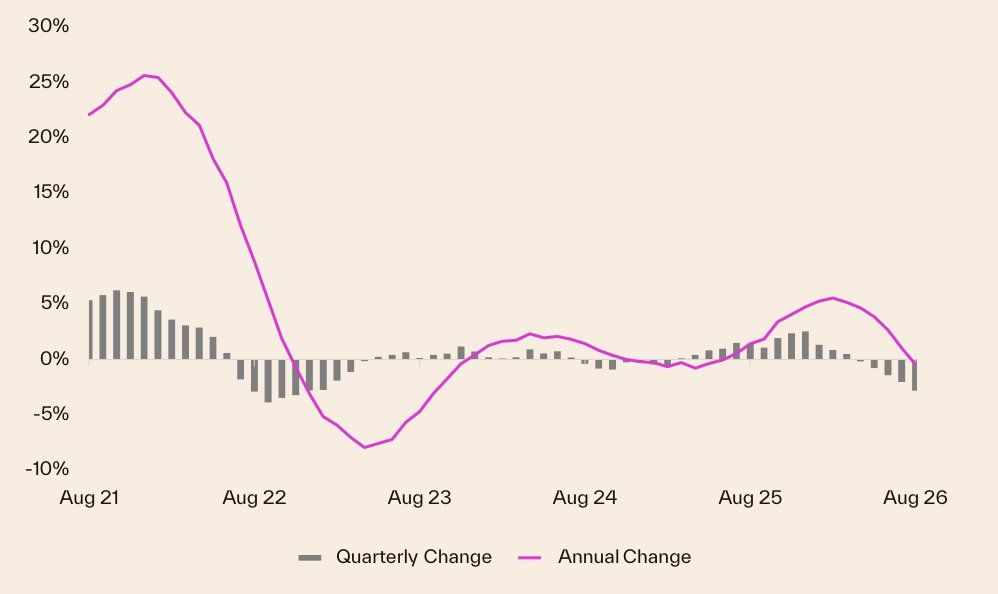
The five-year arc reflects the sharp run-up in values that followed the pandemic, with Canberra peaking in May 2022 before the RBA's rate increases progressively weighed on buyer capacity in a city where public sector employment shapes a large share of the buyer pool. Total listings have since climbed +20.4 per cent above year-ago levels as stock accumulates, and homes are taking longer to sell, together pointing to a market where supply and demand have moved out of balance.
Canberra selling statistics
Canberra's selling conditions in August 2026 present a clear picture: more stock is sitting on the market, properties are taking longer to find buyers, and sellers are accepting offers further below their asking prices than a year ago. Against that backdrop, sales volume has held up better than the broader capital city average, which is a genuine point of difference in an otherwise challenging environment.
Want to know what your own property is worth? Get a free value estimate for your address.
Canberra sales volume and days on market
Sales volume in Canberra rose +6.3 per cent year on year, a result that stands in contrast to the combined capitals aggregate, which fell -5.2 per cent over the same period. Properties took a median of 51 days to sell, one day faster than the 52 days recorded a year ago.
| Canberra sales volume | Canberra days on market |
|---|---|
| +6.3% Change from 12mo ago | 51 days 52 days 12 mo ago |
Source: Cotality
At 51 days, Canberra's median selling time sits well above both the combined capitals figure of 37 days and the national figure of 39 days. That gap tells buyers they have more time to deliberate than they would in most other markets, while sellers need to plan for a longer campaign than the national average suggests.
Canberra new and total listings
New listings in Canberra fell -3.1 per cent year on year, meaning fewer fresh properties came to market over the period. Total listings, by contrast, climbed +20.4 per cent year on year, as properties already on the market took longer to sell and accumulated.
| Canberra new listings | Canberra total listings |
|---|---|
| -3.1% Change from 12mo ago | +20.4% Change from 12mo ago |
Source: Cotality
The combination of fewer new listings and a much larger pool of total listings points to a market where stock is building because buyers are taking longer to commit, not because sellers are flooding the market with new supply. For buyers, that means more choice and less pressure to act quickly. For sellers, it means more competition from other listings already on the market.
Canberra vendor discount and auction clearance rates
Vendor discount measures the percentage gap between the price a property was first listed at and the price it eventually sold for. Auction clearance rate measures the share of properties offered at auction that actually sell on the day. Together, they give a read on how much negotiating room buyers have and how readily sellers are finding buyers at their price.
Canberra vendor discount over time
| August 2026 | August 2025 | |
|---|---|---|
| Canberra median vendor discount | -3.8% | -3.3% |
Source: Cotality
Canberra's median vendor discount widened to -3.8 per cent from -3.3 per cent a year ago. Sellers are accepting offers further below their initial asking prices than they were twelve months ago, reflecting the shift in buyer leverage that the listings and days-on-market figures already suggest.
Canberra auction clearance rates
| Canberra | 6 Sep 2026 |
|---|---|
| Total Auctions | 35 |
| Sold | 13 |
| Withdrawn | 8 |
| Passed in | 14 |
| Clearance Rate | 37.1% |
Source: Cotality
Canberra's clearance rate for the week ending 6 September 2026 came in at 37.1 per cent, with 13 properties sold from 35 reported results and 14 passed in. A rate in the high 30s is a weak result by any long-run benchmark, well into territory that favours buyers, and the volume of properties passed in confirms that price expectations between buyers and sellers remain some distance apart.
Thinking of selling? Compare top-performing local agents in your suburb to find the right fit for your sale.
Get a deeper insight into how Canberra sellers are faring in 2026 and what could be on the horizon for the remainder of the year with some of our latest articles.


Canberra property investing
Canberra's rental market is giving investors a mixed picture right now. Rents are still growing, yields sit above the combined capitals average, but vacancy has risen over the past year, taking some pressure off tenants and adding a note of caution for landlords.
Helpful resource: Estimate the capital gains tax on a sale with our free calculator.
Canberra rental market
The table below covers annual rent growth, gross rental yield, and how house and unit rents have moved over the past year across all capital cities and broader national measures. Canberra's position in each column tells a clear story about where the market sits relative to the rest of the country.
| Location | Rental rates | Rental yield | Annual change in rents, houses | Annual change in rents, units |
|---|---|---|---|---|
| National | 5.7% | 3.8% | NA | NA |
| Combined Capitals | 5.7% | 3.6% | NA | NA |
| Combined Regional | 5.8% | 4.3% | NA | NA |
| Sydney | 4.8% | 3.3% | 5.3% | 3.9% |
| Melbourne | 5.0% | 4.0% | 5.1% | 4.9% |
| Brisbane | 6.4% | 3.4% | 6.7% | 5.6% |
| Adelaide | 5.8% | 3.6% | 5.8% | 6.0% |
| Perth | 8.0% | 3.9% | 8.1% | 7.4% |
| Hobart | 7.9% | 4.4% | 8.5% | 6.0% |
| Darwin | 11.4% | 6.3% | 12.0% | 10.5% |
| Canberra | 3.2% | 4.3% | 4.0% | 1.4% |
Source: Cotality
Canberra's annual rent growth of +3.2 per cent is the softest of any capital, sitting well below the national figure of +5.7 per cent. The gap between house rents (+4.0 per cent) and unit rents (+1.4 per cent) is notable: unit rents have grown only modestly, which points to an easing of pressure in the higher-density segment specifically.
The gross yield of 4.3 per cent is a relative bright spot. It matches Hobart and sits clearly above the combined capitals average of 3.6 per cent, meaning Canberra's rental income holds up reasonably well against property values, even as rent growth has slowed.
Canberra vacancy rates
The vacancy rate is the share of rental properties sitting empty at any given time. A rising rate generally signals more choice for tenants and less pricing power for landlords. SQM data shows that Canberra's vacancy rate has moved materially over the past twelve months.
| Location | Aug 2026 vacancy rates | Aug 2026 vacancies | Aug 2025 vacancy rates | Aug 2025 vacancies |
|---|---|---|---|---|
| National | 1.3% | 41,039 | 1.2% | 37,742 |
| Sydney | 1.7% | 12,821 | 1.4% | 10,211 |
| Melbourne | 1.8% | 9,534 | 1.8% | 9,620 |
| Brisbane | 0.9% | 3,090 | 1.0% | 3,423 |
| Adelaide | 0.6% | 1,019 | 0.8% | 1,257 |
| Perth | 0.6% | 1,192 | 0.7% | 1,389 |
| Hobart | 0.6% | 158 | 0.5% | 144 |
| Darwin | 0.4% | 94 | 0.5% | 134 |
| Canberra | 2.1% | 1,264 | 1.6% | 978 |
Source: SQM Research
Canberra's vacancy rate has risen from 1.6 per cent a year ago to 2.1 per cent now, with empty properties climbing from 978 to 1,264. That +0.5 percentage point move is the largest year-on-year increase of any capital in the table, and it leaves Canberra's vacancy rate clearly above the national figure of 1.3 per cent.
While most capitals are running tight, with Brisbane, Adelaide, Perth and Darwin all below 1 per cent, Canberra is moving in the opposite direction. More available stock relative to demand is the straightforward explanation: tenants have more options here than they did twelve months ago, and that pattern is keeping rent growth contained.
Louis Christopher, Managing Director at SQM Research said in the latest rental market report:
"The national vacancy rate is 1.3%, but that hides a market moving in two directions. Sydney has 26% more vacancies than a year ago and Canberra 29% more, while Brisbane, Perth, Adelaide and Darwin have fewer than they did last August."
Mr Christopher's observation maps directly onto what Canberra's figures show. A 29 per cent rise in vacant properties over the year is a meaningful shift in the balance between supply and demand, and it helps explain why rent growth here has lagged every other capital. For investors, the direction of vacancy is the key variable to watch: if the rate continues to edge higher into the spring leasing season without a corresponding lift in demand, rent growth is likely to remain at the softer end of the national range.
Highest growth areas in Canberra
Canberra's SA3 regions, Statistical Area Level 3 districts, an Australian Bureau of Statistics classification that typically groups several adjacent suburbs, show a wide spread of annual results in August 2026. The table below ranks all eight available SA3s from strongest to weakest annual price change, giving a clear picture of where values have held up and where they have pulled back most.
| Rank | SA3 Name | SA4 Name | Median Value | Annual % Change |
|---|---|---|---|---|
| 1 | Weston Creek | ACT | $987,787 | +4.1% |
| 2 | Tuggeranong | ACT | $880,768 | +1.8% |
| 3 | Gungahlin | ACT | $904,330 | -0.1% |
| 4 | Belconnen | ACT | $838,927 | -0.7% |
| 5 | Molonglo | ACT | $747,241 | -0.7% |
| 6 | South Canberra | ACT | $755,703 | -1.3% |
| 7 | Woden Valley | ACT | $950,112 | -1.5% |
| 8 | North Canberra | ACT | $711,942 | -3.9% |
Source: Cotality
- Weston Creek: Ranked #1 with annual growth of +4.1 per cent and a median value of $987,787, Weston Creek is the only Canberra SA3 to post meaningful gains over the past year. Suburbs such as Chapman and Stirling have drawn steady buyer interest, supported by the area's established green streetscapes, proximity to the Molonglo corridor, and relative value compared with inner-north equivalents.
- Tuggeranong: Ranked #2 with annual growth of +1.8 per cent and a median of $880,768, Tuggeranong has held its ground better than most of Canberra's districts. The region's relative affordability, with suburbs including Kambah and Wanniassa sitting well below the city median, appears to have kept a floor under demand even as conditions across the capital have softened.
- Gungahlin: Ranked #3 with an annual change of -0.1 per cent and a median of $904,330, Gungahlin is essentially flat over the year. The district continues to attract families and first-time buyers drawn to newer housing stock in suburbs such as Casey and Franklin, though the pace of price growth that characterised the area through 2023 and 2024 has not been sustained.
- Middle-ring districts: Ranks #4 and #5, Belconnen (-0.7 per cent, $838,927) and Molonglo (-0.7 per cent, $747,241), recorded identical annual declines and sit at opposite ends of the city's price spectrum. Belconnen suburbs such as Kaleen offer established housing at relatively accessible price points, while Molonglo's newer estates, including Denman Prospect and Coombs, reflect the softer demand for off-the-plan and recently completed stock in the current rate environment.
- Established inner and south-side districts: Ranks #6 through #8, South Canberra (-1.3 per cent, $755,703), Woden Valley (-1.5 per cent, $950,112) and North Canberra (-3.9 per cent, $711,942), recorded the largest annual declines of any Canberra district. Despite carrying some of the city's most sought-after addresses, including Kingston and Narrabundah in South Canberra and suburbs such as Ainslie and Lyneham in the north, these inner areas have seen values pull back the furthest from their 2022 peaks, consistent with a broader pattern of price correction being most pronounced where values ran hardest during the upswing.
Thinking of selling or investing in Canberra? Compare local agents or get a free property report with OpenAgent.
View agent & property tools

Our powerful property tools


 - https://sketch.com --%3e %3ctitle%3eicons / icon-chevron-down%3c/title%3e %3cdesc%3eCreated with Sketch.%3c/desc%3e %3cg id='icons-/-icon-chevron-down' stroke='none' stroke-width='1' fill='none' fill-rule='evenodd'%3e %3crect id='Icon-container' x='0' y='0' width='24' height='24'%3e%3c/rect%3e %3cpolygon id='Shape' fill='%2300AB55' points='12 14.3357864 5.20710678 7.54289322 3.79289322 8.95710678 12 17.1642136 20.2071068 8.95710678 18.7928932 7.54289322'%3e%3c/polygon%3e %3c/g%3e%3c/svg%3e)