Record resale profits: what the data means for Australian sellers

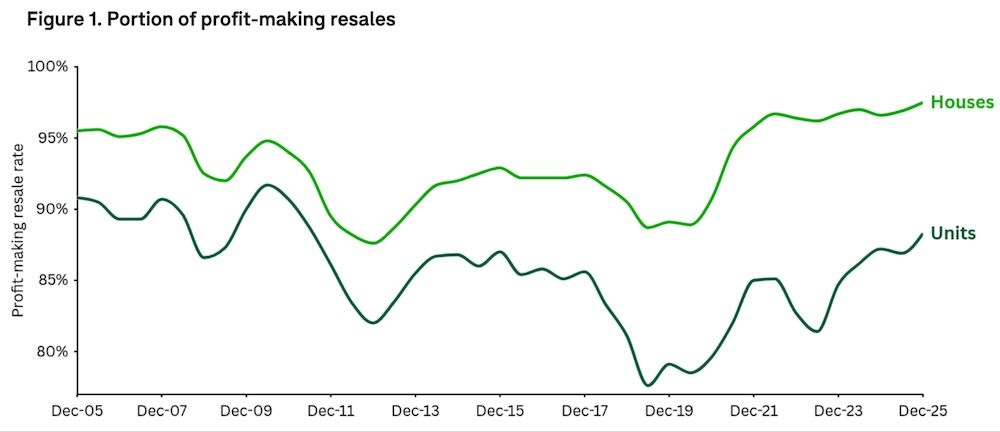
For all the uncertainty hanging over Australia's property market right now, the latest resale data contains a figure that puts things into perspective: 97.5 per cent of house sellers are making a profit.
That's a record ratio of profit-makers, according to Domain's 2026 Profit and Loss Report, and it offers a timely reminder that property is a long-term game.
As the report describes it, Australia is experiencing an "equity surge" that showcases the depth of housing wealth across the country.

Get a free property value estimate
Find out how much your property is worth in today’s market.
For the first time in around 15 years, every Australian capital city recorded more than 90 per cent of house resales delivering a gain.
The last time that was true was during the mining investment boom of 2011 to 2013, which gives a sense of just how broadly equity has accumulated through the recent price cycle.
The national figures break down as follows:
| Houses | Units | |
|---|---|---|
| % of reales at a profit | 97.5% | 88.3% |
| Median resale profit | $440,000 | $228,000 |
| % of resales at a loss | 2.5% | 11.7% |
| Median resale loss | -$75,000 | -$50,000 |
The median house profit of $440,000 means the typical seller who transacted in the second half of 2025 walked away with nearly half a million dollars more than they originally paid.
Domain's report also highlighted what happens to those gains once they're realised. Rather than simply sitting on paper, that equity gets recycled into the market through upgrading, downsizing and intergenerational wealth transfers, helping sustain housing demand even as affordability pressures persist.
For most sellers, the picture is clear: years in the market have already done the heavy lifting, regardless of what's happening in the headlines this week.

How every capital city market performed
Brisbane and Perth are the standout performers, with both cities recording 99.5 per cent of house resales at a profit — record-high proportions for each.
Their median house resale profits of $580,000 and $528,000 respectively are also records, reflecting the strength and breadth of price growth in both cities since 2021.
| Market | % profitable (houses) | Median profit (houses) | % profitable (units) | Median profit (units) |
|---|---|---|---|---|
| Sydney | 97.9% | $750,000 | 87.2% | $216,288 |
| Melbourne | 95.9% | $390,000 | 75.4% | $122,000 |
| Brisbane | 99.5% | $580,000 | 99.1% | $325,000 |
| Adelaide | 98.2% | $539,500 | 96.6% | $290,000 |
| Perth | 99.5% | $528,000 | 96.8% | $226,050 |
| Hobart | 94.3% | $330,000 | 95.8% | $203,500 |
| Canberra | 93.1% | $370,000 | 87.4% | $106,100 |
| Darwin | 94.9% | $201,000 | 72.0% | $78,500 |
Despite its softer recent price momentum, Sydney remains the nation's largest reservoir of housing equity. A median house resale profit of $750,000 — the highest nationally — reflects the amplifying effect of higher entry prices and longer holding periods.
Melbourne attracts more than its share of negative headlines, but the data tells a more balanced story. Close to 96 per cent of Melbourne house sellers transacted at a profit, with a median gain of $390,000.
The unit picture is more varied across the capitals. Brisbane's apartment market has undergone what Domain calls a structural shift, with more than 99 per cent of unit resales profitable and a record median gain of $325,000, driven by population growth, tight rental conditions and constrained new supply.
Melbourne units are the softest spot nationally at 75.4 per cent profitable, with elevated inner-city supply and higher investor exposure making resale outcomes more sensitive to timing. Darwin units, at 72 per cent profitable, are the only other market sitting meaningfully below the national average.
The picture extends well beyond the capitals, too. Across regional Australia, 97.3 per cent of house resales delivered a gain, with a median profit of $330,000. Queensland and NSW regional markets led the way, posting median profits of $395,000 and $350,500 respectively.
Across every capital and region, the consistent theme is the same: loss-making sales remain very much the exception, not the rule.

Why most sellers come out ahead
The most important context behind these figures is one that tends to get lost in the noise.
The typical Australian property owner holds their home for around nine years before selling, and that holding period is the real reason these profits exist.
They are not the product of perfect market timing. They are the product of time in the market, with capital growth compounding across multiple cycles, including previous periods of rate rises not unlike what we're navigating now.
Domain's report makes this point directly, noting that extended holding periods mean most resales reflect multiple market cycles rather than short-term timing. In other words, the sellers realising these gains didn't need to pick the perfect moment — they simply held on.
Profitability is also not confined to prestige suburbs or blue-chip postcodes. Across multiple capitals, middle-ring suburban markets recorded near-universal profit rates, confirming that the recent growth cycle has lifted the broad middle of the market, not just the top end.
The current rate environment is not painless, particularly for recent buyers carrying higher levels of debt. But for most sellers, the data offers a straightforward message: if you've owned your home for a few years, chances are the market has already done the hard work for you.
Rate headlines will keep changing. The long-term case for Australian property, as this report makes clear, hasn't.