
 - https://sketchapp.com --%3e %3ctitle%3eIcon/search%3c/title%3e %3cdesc%3eCreated with Sketch.%3c/desc%3e %3cg id='Icon/search' stroke='none' stroke-width='1' fill='none' fill-rule='evenodd' stroke-linecap='round' stroke-linejoin='round'%3e %3ccircle id='Oval' stroke='%23252525' cx='10.5145111' cy='10.5145111' r='6.99455261'%3e%3c/circle%3e %3cpath d='M15.4908752%2c15.4908752 L20.5515137%2c20.5515137' id='Line' stroke='%23252525'%3e%3c/path%3e %3c/g%3e%3c/svg%3e)


Perth property market news - key takeaways
- Perth property market easing: Perth dwelling values fell -0.8 per cent in August 2026 and are now -3.2 per cent below the April 2026 peak, though annual growth of +15.6 per cent reflects the scale of the preceding upswing.
- Stock levels rising sharply: Total listings in Perth climbed +53.3 per cent year on year, giving buyers considerably more choice than at any point in the past two years.
- Vendors accepting larger discounts: Perth sellers are conceding -4.4 per cent below their initial asking price, up from -2.9 per cent a year ago, as properties take longer to sell with days on market rising from 12 to 22 days.
- Rental demand stays strong: Perth's vacancy rate sits at just 0.6 per cent with annual rent growth of +8.0 per cent, well above the national figure of +5.7 per cent.
- Rate rise on the horizon: All four major banks expect the RBA cash rate to rise a further 25 basis points to 4.60 per cent, with NAB forecasting a move as early as September 2026.

Get a free property value estimate
Find out how much your property is worth in today’s market.
Perth property price movements
The Perth property market has pulled back from its record highs, with values declining over both the month and the quarter in August 2026. Annual growth remains strongly positive, a reflection of how far prices ran during the preceding upswing.
Perth property prices - August 2026
Perth home values fell -0.8 per cent in August 2026, bringing the median to $999,987. The quarterly picture tells a similar story, with values down -3.2 per cent over the three months to August, while the annual measure held at +15.6 per cent.
| Property type | Current median price | Monthly change | Quarterly change | Annual change |
|---|---|---|---|---|
| All Perth dwellings | $999,987 | -0.8% | -3.2% | +15.6% |
Source: Cotality
The monthly movement translates to a fall of around $8,065 in the median home value over the month. Values now sit -3.2 per cent below the April 2026 peak, meaning the market has given back a portion of an exceptional growth run rather than erased it.
House prices in Perth
Perth house prices followed the broader market lower in August 2026, slipping -0.7 per cent over the month to a median of $1,043,478. The quarterly decline reached -3.0 per cent, though annual growth of +15.6 per cent reflects the scale of gains recorded over the prior year.
| Property type | Current median price | Monthly change | Quarterly change | Annual change |
|---|---|---|---|---|
| Perth houses | $1,043,478 | -0.7% | -3.0% | +15.6% |
Source: Cotality
The monthly movement equates to a fall of around $7,352 in the median house value. Houses and units moved in the same direction over the month, though the gap between their quarterly declines is notable, with units falling more steeply over the three-month period.
Unit prices in Perth
Perth unit prices fell -1.0 per cent in August 2026 to a median of $733,223, a sharper monthly decline than recorded for houses. Annual growth for Perth unit prices reached +16.0 per cent, fractionally above the house figure for the same period.
| Property type | Current median price | Monthly change | Quarterly change | Annual change |
|---|---|---|---|---|
| Perth units | $733,223 | -1.0% | -4.1% | +16.0% |
Source: Cotality
The monthly fall represents a drop of around $7,407 in the median unit value. Over the quarter, units declined -4.1 per cent, compared with -3.0 per cent for houses, suggesting units have softened more quickly from their peak as buyer demand has eased.
Perth property market forecasts 2026
Australia's Big Four banks, CBA, Westpac, NAB, and ANZ, publish annual house price forecasts as part of their economic research, and their views on Perth for 2026 differ considerably. The spread is wide enough that where you land on the range matters for how you read the year ahead.
- CBA predicts Perth property prices to rise +12.0 per cent over 2026.
- Westpac predicts Perth property prices to rise +13.0 per cent over 2026.
- NAB predicts Perth property prices to rise +5.0 per cent over 2026.
- ANZ predicts Perth property prices to rise +8.3 per cent over 2026.
Westpac sits at the optimistic end of the Perth house price forecast range at +13.0 per cent, while NAB is the most conservative of the four at +5.0 per cent, a gap of eight percentage points. CBA's +12.0 per cent sits near the top of that spread, and ANZ's +8.3 per cent lands closer to the midpoint between the two extremes. All four banks still expect positive full-year growth, even as conditions have softened since April.
RBA cash rate forecast 2026-2027
The RBA cash rate currently sits at 4.35 per cent, reflecting a series of increases from the 3.60 per cent rate that preceded the current tightening phase. All four major banks expect the next move to be a rise, though their timing differs slightly, with NAB forecasting the earliest move and the others pointing to November.
- ANZ expects the next cash-rate move to be a 25 basis point rise in November 2026, bringing the cash rate to 4.60 per cent.
- CBA expects the next cash-rate move to be a 25 basis point rise in November 2026, bringing the cash rate to 4.60 per cent.
- NAB expects the next cash-rate move to be a 25 basis point rise in September 2026, forecasting a risk of a further rise in November 2026 to bring the cash rate to 4.60 per cent.
- Westpac expects the next cash-rate move to be a 25 basis point rise in November 2026, bringing the cash rate to 4.60 per cent.
Sally Tindall, Data Insights Director at Canstar said of the rate outlook:
"The economic narrative has taken a U-turn in the space of just a couple of days."
For Perth borrowers already navigating higher repayments at 4.35 per cent, the prospect of a further rise to 4.60 per cent adds meaningful pressure to household budgets.
What this means for the Perth market
A cash rate at 4.35 per cent already puts Perth borrowers under considerable strain, given that the median dwelling value is just under $1,000,000. A further 25 basis point rise would add to monthly repayments at a time when values have already pulled back -3.2 per cent from the April 2026 peak.
Perth house price trend data shows the market easing on both a monthly and quarterly basis, and the rate outlook compounds the pressure on buyers weighing up how much they can borrow. Units are feeling this more acutely than houses, having fallen -4.1 per cent over the quarter compared with -3.0 per cent for houses, suggesting more price-sensitive segments are adjusting fastest to the tighter lending environment.
Helpful resource: Our simple guide to tracking market trends and data will walk you through everything you need to know to be able to read the market and make a smarter selling decision.
Perth house prices graphs and charts
Perth's house price growth over the last 5 years has been one of the more pronounced runs of any Australian capital, though the most recent figures show values easing from that peak: according to Cotality's latest figures, Perth dwelling values fell -0.8 per cent over the month and -3.2 per cent over the quarter to August 2026, while still sitting +15.6 per cent higher than a year ago, with a current median of $999,987.
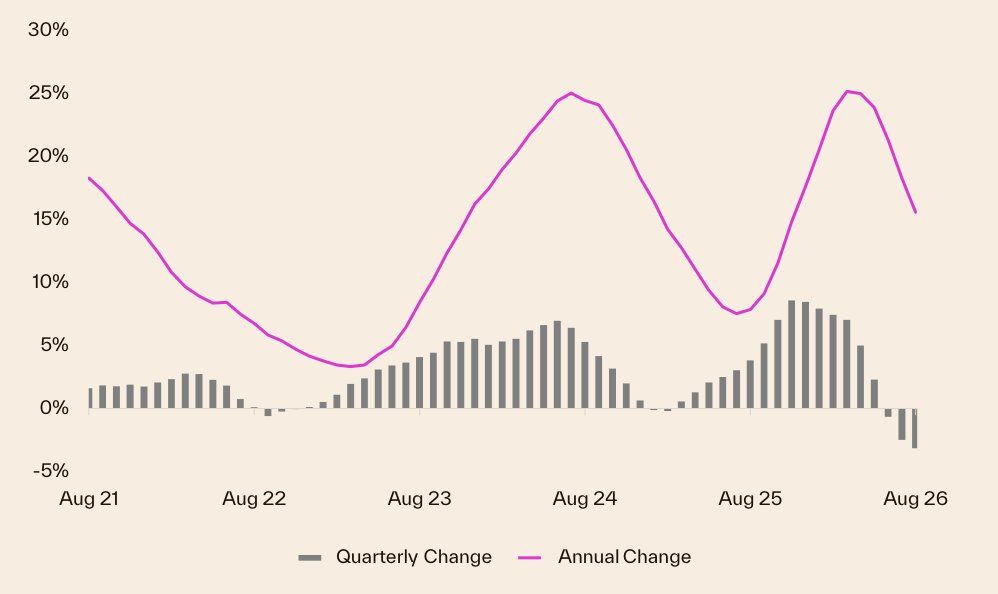
The five-year run was driven by a combination of strong interstate migration, a tight rental market, and limited new housing supply, conditions that kept buyer demand well ahead of available stock for an extended period. The cash rate rising to 4.35 per cent has since shifted that balance, with buyer activity pulling back, total listings rising sharply, and properties now taking nearly twice as long to sell as they did a year ago.
Perth property 30 year property price graph
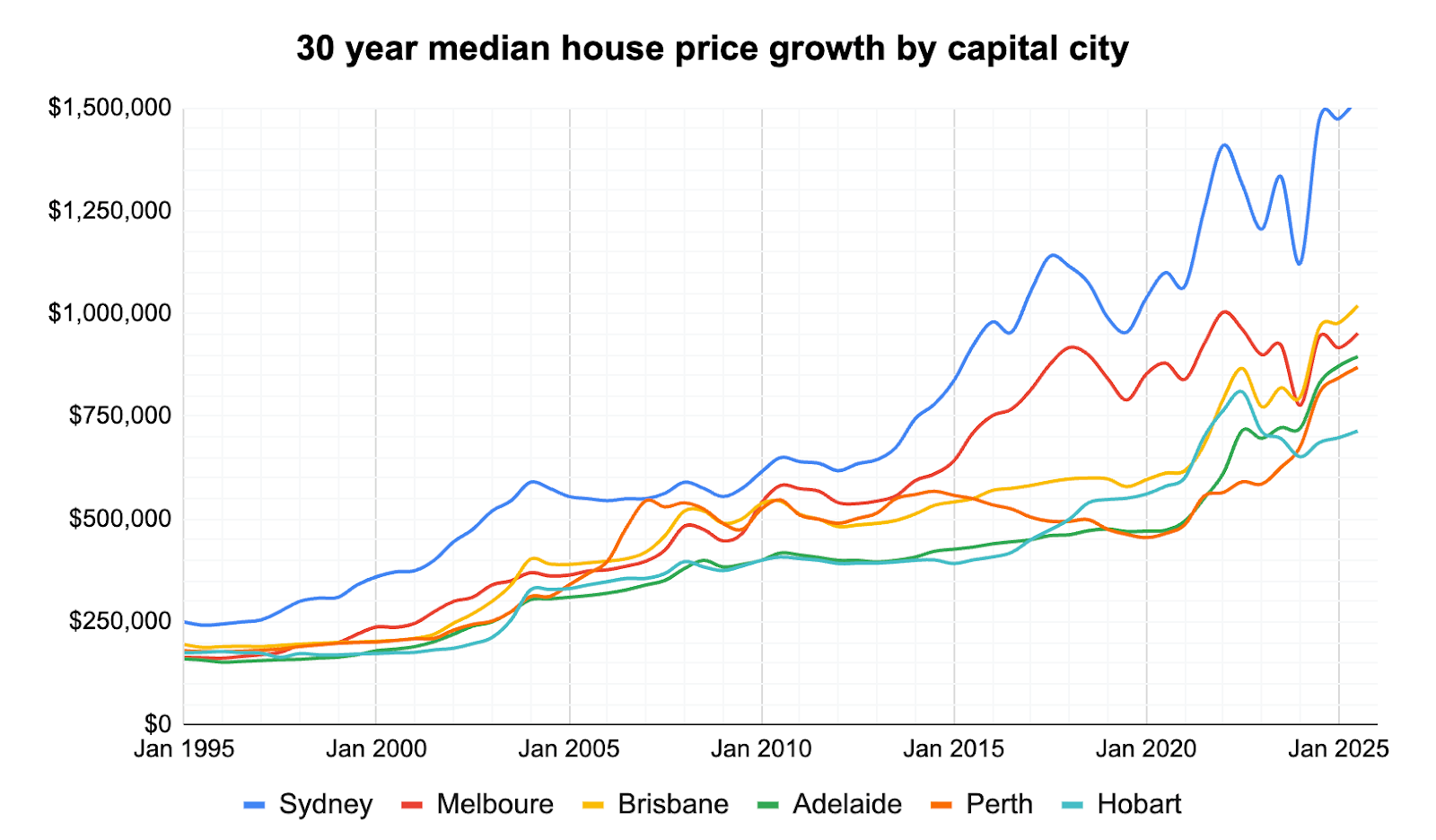
Recent gains sit on top of a long, cyclical history where booms and busts have tended to follow the state’s resource cycles, so Perth property prices growth over the last 10 years has been uneven — a long slump after the 2014 peak was followed by a powerful recovery and the current run to new highs around the $960,000 median range.
Over three decades, the market has been driven by shifting mining fortunes, changing population flows and periods of under-building that later tightened supply. Today, those same forces — stronger population growth, very low vacancy rates and limited new listings — are supporting prices. Homeowners are generally feeling more confident after recent gains, while buyers report frustration and urgency because higher repayments and scarce stock make finding and affording a home harder right now.
Perth selling statistics
Perth's selling conditions have shifted noticeably over the past year. Fewer transactions are being settled, properties are taking longer to find a buyer, and the pool of available stock has grown sharply. Buyers now have more time and more choice than they had through the tighter conditions of 2024 and early 2025.
Want to know what your own property is worth? Get a free value estimate for your address.
Perth sales volume and days on market
Sales volumes in Perth fell -15.8 per cent year on year, a steeper decline than the -5.2 per cent recorded across the combined capitals and the -2.7 per cent nationally. At the same time, the median days on market extended to 22 days, up from 12 days a year ago.
| Perth sales volume | Perth days on market |
|---|---|
| -15.8% Change from 12mo ago | 22 days 12 days 12 mo ago |
Source: Cotality
Perth's sales volume decline is considerably larger than the combined capitals and national figures, suggesting the pullback in buyer activity here has been more pronounced than elsewhere. At 22 days, Perth still clears properties faster than the combined capitals average of 37 days and the national figure of 39 days, meaning sellers here are transacting in roughly half the time it takes in many other markets.
Perth new and total listings
New listings in Perth rose +19.8 per cent year on year, while total listings climbed +53.3 per cent over the same period. That is a substantial accumulation of available stock in a short space of time.
| Perth new listings | Perth total listings |
|---|---|
| +19.8% Change from 12mo ago | +53.3% Change from 12mo ago |
Source: Cotality
The sharp rise in total listings reflects a market where properties are sitting for longer before selling, causing available stock to build up even as each month's fresh supply continues to arrive. Buyers now have considerably more to choose from than at any point in the past two years, which shifts negotiating conditions relative to the very tight market that drove Perth's extended price run through 2024 and 2025.
Perth vendor discount
The vendor discount measures the percentage gap between the price a seller initially asks for a property and the price at which it eventually sells. A wider discount means sellers are accepting offers further below their initial asking price. Weekly auction clearance rates are not included for Perth because auction volumes are too low to be statistically meaningful.
| August 2026 | August 2025 | |
|---|---|---|
| Perth median vendor discount | -4.4% | -2.9% |
Source: Cotality
Perth vendors are currently accepting offers -4.4 per cent below their initial asking price, compared with -2.9 per cent a year ago. That widening of 1.5 percentage points over twelve months is consistent with a market where buyer leverage has increased alongside the rise in available stock and the slowdown in sales activity.
Thinking of selling? Compare top-performing local agents in your suburb to find the right fit for your sale.
Get a deeper insight into how Perth sellers are faring in 2026 and what could be on the horizon for the remainder of the year with some of our latest articles.




Perth property investing
Perth's rental market continues to run hot even as property values ease from their April 2026 peak. For renters, that means finding a place to live remains genuinely difficult. For investors, strong rent growth and a vacancy rate well below the national figure keep Perth on the radar as an income-producing market.
Helpful resource: Estimate the capital gains tax on a sale with our free calculator.
Perth rental market
The table below covers annual rent growth for houses and units, plus gross rental yield, the annual rent expressed as a percentage of the property's value, across all capitals and key national benchmarks.
| Location | Rental rates | Rental yield | Annual change in rents, houses | Annual change in rents, units |
|---|---|---|---|---|
| National | 5.7% | 3.8% | NA | NA |
| Combined Capitals | 5.7% | 3.6% | NA | NA |
| Combined Regional | 5.8% | 4.3% | NA | NA |
| Sydney | 4.8% | 3.3% | 5.3% | 3.9% |
| Melbourne | 5.0% | 4.0% | 5.1% | 4.9% |
| Brisbane | 6.4% | 3.4% | 6.7% | 5.6% |
| Adelaide | 5.8% | 3.6% | 5.8% | 6.0% |
| Perth | 8.0% | 3.9% | 8.1% | 7.4% |
| Hobart | 7.9% | 4.4% | 8.5% | 6.0% |
| Darwin | 11.4% | 6.3% | 12.0% | 10.5% |
| Canberra | 3.2% | 4.3% | 4.0% | 1.4% |
Source: Cotality
Perth posted the strongest annual rent growth of all the southern and eastern capitals at +8.0 per cent, with houses (+8.1 per cent) and units (+7.4 per cent) both tracking well above the national figure of +5.7 per cent. The gross yield of 3.9 per cent sits above the combined capitals average of 3.6 per cent, suggesting Perth values have not yet run as far ahead of rents as they have in markets like Sydney or Brisbane, where yields are tighter despite strong recent price growth.
Perth vacancy rates
The vacancy rate is the share of available rental properties sitting empty at any given time. A rate below around 2 per cent generally signals that rental supply is tight and landlords hold the stronger negotiating position. SQM data shows that Perth's vacancy rate edged lower from 0.7 per cent a year ago to 0.6 per cent in August 2026.
| Location | Aug 2026 vacancy rates | Aug 2026 vacancies | Aug 2025 vacancy rates | Aug 2025 vacancies |
|---|---|---|---|---|
| National | 1.3% | 41,039 | 1.2% | 37,742 |
| Sydney | 1.7% | 12,821 | 1.4% | 10,211 |
| Melbourne | 1.8% | 9,534 | 1.8% | 9,620 |
| Brisbane | 0.9% | 3,090 | 1.0% | 3,423 |
| Adelaide | 0.6% | 1,019 | 0.8% | 1,257 |
| Perth | 0.6% | 1,192 | 0.7% | 1,389 |
| Hobart | 0.6% | 158 | 0.5% | 144 |
| Darwin | 0.4% | 94 | 0.5% | 134 |
| Canberra | 2.1% | 1,264 | 1.6% | 978 |
Source: SQM Research
Perth's 0.6 per cent vacancy rate sits well below the national figure of 1.3 per cent, placing it among the tightest rental markets in the country. The year-on-year movement is modest, down from 0.7 per cent, and the number of vacant properties fell from 1,389 to 1,192 over the same period. The contrast with Sydney and Canberra, where vacancies have risen sharply over the past year, shows how differently conditions are playing out across the capitals.
Louis Christopher, Managing Director at SQM Research said in the latest rental market report:
"The national vacancy rate is 1.3%, but that hides a market moving in two directions. Sydney has 26% more vacancies than a year ago and Canberra 29% more, while Brisbane, Perth, Adelaide and Darwin have fewer than they did last August."
Perth's position maps directly onto that observation. With fewer vacant properties than a year ago and a rate less than half the national figure, Perth tenants are competing for a pool of available rentals that has not meaningfully grown. For investors, that persistent shortage of available stock is one of the key reasons rents have continued to climb at well above the national pace.
Highest growth areas in Perth
Perth's strongest annual price gains in August 2026 were concentrated across the city's outer southern, southeastern and northern corridors, with every region in the top 10 posting double-digit growth over the year. The table below covers the top 10 Statistical Area Level 3 (SA3) regions for Greater Perth. An SA3 is an Australian Bureau of Statistics geographic classification that typically groups several adjacent suburbs into a single region.
| Rank | SA3 Name | SA4 Name | Median Value | Annual % Change |
|---|---|---|---|---|
| 1 | Serpentine - Jarrahdale | South East | $940,039 | +21.7% |
| 2 | Mandurah | Mandurah | $889,215 | +20.0% |
| 3 | Rockingham | South West | $901,396 | +19.5% |
| 4 | Swan | North East | $926,488 | +18.6% |
| 5 | Mundaring | North East | $1,002,219 | +18.6% |
| 6 | Armadale | South East | $880,064 | +18.3% |
| 7 | Wanneroo | North West | $962,729 | +17.5% |
| 8 | Stirling | North West | $1,088,227 | +17.5% |
| 9 | Kalamunda | South East | $1,045,791 | +17.4% |
| 10 | Cockburn | South West | $1,093,614 | +17.2% |
Source: Cotality
Highlights for Perth’s high growth areas
- Serpentine - Jarrahdale: Ranked #1 with annual growth of +21.7 per cent and a median value of $940,039, Serpentine - Jarrahdale sits in Perth's outer south-east and has drawn steady buyer interest from those seeking larger landholdings at prices well below the inner-city market. Suburbs such as Byford and Mundijong have been among the busier pockets in the region, supported by ongoing residential development and improving road connections to the city.
- Mandurah: Ranked #2 with +20.0 per cent annual growth and a median of $889,215, Mandurah remains one of the more affordable coastal options within reach of Perth, and that relative value has kept buyer demand firm through the growth cycle. Suburbs such as Halls Head and Meadow Springs sit within this SA3 and have attracted buyers looking for waterside lifestyle at a lower entry point than metropolitan alternatives.
- Rockingham: Ranked #3 with +19.5 per cent annual growth and a median of $901,396, Rockingham covers a broad stretch of Perth's southern coast and has benefited from its combination of coastal amenity and comparatively accessible price points. Baldivis and Secret Harbour are among the better-known suburbs in the region, with new residential estates drawing families relocating from more expensive parts of the city.
- Outer southeast growth corridor: Ranks #4 through #6, Swan (+18.6 per cent, $926,488), Mundaring (+18.6 per cent, $1,002,219) and Armadale (+18.3 per cent, $880,064), form a broad arc through Perth's outer southeast and northeast, where buyers seeking space and relative affordability have continued to push demand. Swan includes established suburbs such as Ellenbrook and Midland, Mundaring draws buyers toward hillside settings in areas like Glen Forrest and Mount Helena, and Armadale's Kelmscott and Piara Waters have attracted strong interest from first-home buyers and investors alike.
- Northern and southern mid-ring: Ranks #7 through #10, Wanneroo (+17.5 per cent, $962,729), Stirling (+17.5 per cent, $1,088,227), Kalamunda (+17.4 per cent, $1,045,791) and Cockburn (+17.2 per cent, $1,093,614), round out the top 10 with a spread across Perth's north, east and south. Wanneroo's Alkimos and Yanchep have attracted buyers drawn by coastal-fringe living and active land-release activity, while Stirling's Scarborough and Dianella represent a mid-ring proposition where established infrastructure and proximity to the coast have underpinned ongoing demand.
Thinking of selling or investing in Perth? Compare local agents or get a free property report with OpenAgent.
View agent & property tools

Our powerful property tools


 - https://sketch.com --%3e %3ctitle%3eicons / icon-chevron-down%3c/title%3e %3cdesc%3eCreated with Sketch.%3c/desc%3e %3cg id='icons-/-icon-chevron-down' stroke='none' stroke-width='1' fill='none' fill-rule='evenodd'%3e %3crect id='Icon-container' x='0' y='0' width='24' height='24'%3e%3c/rect%3e %3cpolygon id='Shape' fill='%2300AB55' points='12 14.3357864 5.20710678 7.54289322 3.79289322 8.95710678 12 17.1642136 20.2071068 8.95710678 18.7928932 7.54289322'%3e%3c/polygon%3e %3c/g%3e%3c/svg%3e)